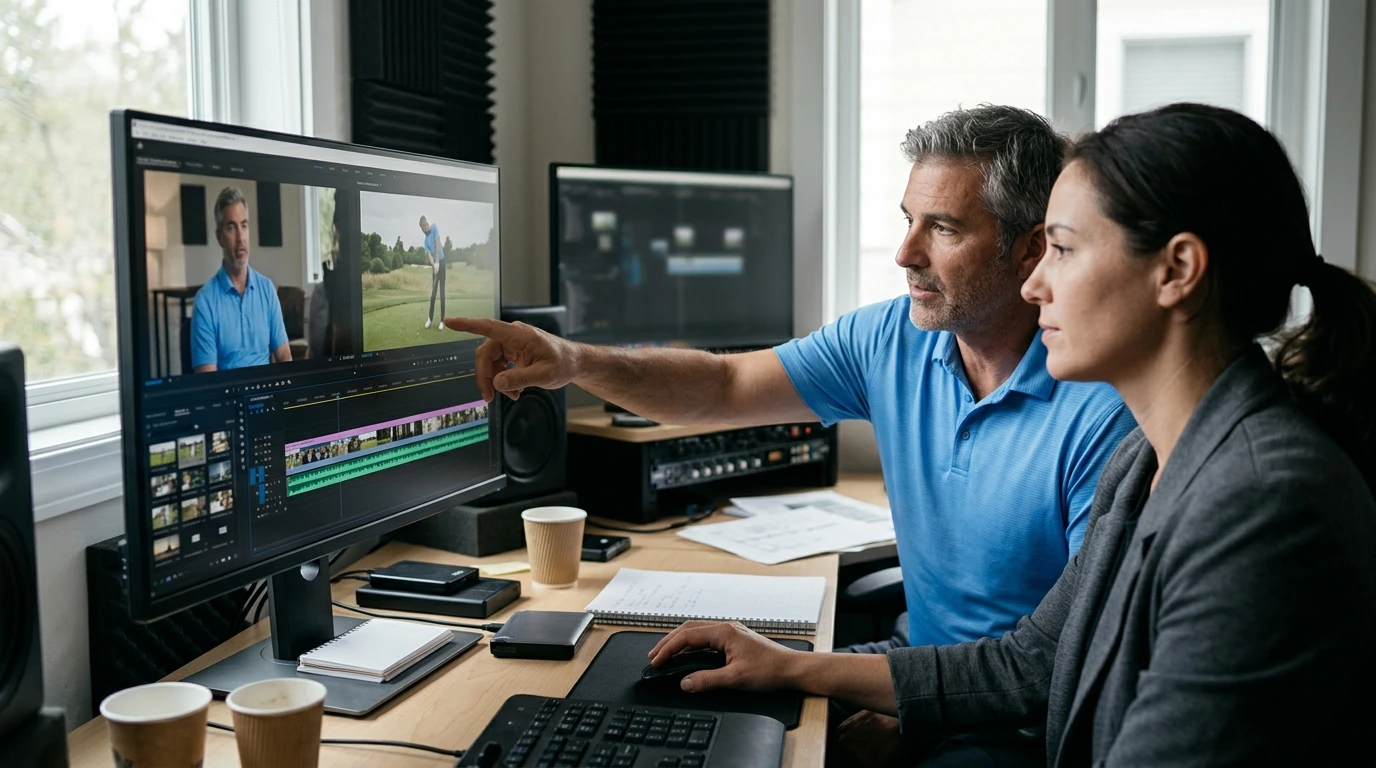
We use video editing services to give personal-brand footage a coherent identity, so audiences recognize your perspective and have a reason to return. Avello Brand Company combines photography, editing, and captioning with cinematic and documentary storytelling. Choosing the right support starts with identifying what your footage needs: routine assembly, narrative development, or production beyond the edit.

Key Takeaways
- Choose an editor by how much story development your footage requires, rather than by the number of finished clips alone.
- Request separate scope details for narrative editing, sound treatment, captions, and platform-specific versions.
- Compare quotes against the same footage and deliverables. A low price means little when essential work sits outside the agreement.
- Approve the story before final color, graphics, and captions to avoid paying for polish on a sequence that still needs restructuring.
Table of Contents
What should you evaluate before choosing an editor?
The right editor must resolve your main creative constraint while working within your review process. Story judgment is the first criterion when your footage contains interviews, incomplete sequences, or moments whose significance needs explanation; execution speed matters more when you already supply approved scripts and repeatable formats.
At Avello Brand Company, we approach personal-brand imagery through cinematic and documentary storytelling, where audience perception develops through the relationship between a person’s words and the images that support them. A golf video, for example, can communicate composure through an uninterrupted pre-shot routine or communicate perseverance through the relationship between a missed approach and the next decision. Those are editorial choices.
Evaluate providers on narrative responsibility, consistency of visual identity, delivery scope, and review access. Ask who selects the meaningful moments, how the editor maintains your established look, whether each destination receives a considered version, and how feedback reaches the person making the cut.
Portfolio relevance matters more than spectacle. When reviewing our Video Guide Gallery, or any editor’s samples, look for work with similar source material and ask what the provider actually handled. A polished montage reveals little about their ability to shape an unscripted interview.
Which type of video editing services fits your brand?
Freelancers, subscription teams, and production partners serve different levels of creative responsibility. The comparison below uses Strong, Conditional, and Limited as suitability ratings for each service model, rather than measured performance scores; an individual provider’s contract and work samples should determine your final judgment.
Choose an independent editor if your footage is ready and your main need is editorial craft. Choose a subscription team if the format is settled and you need dependable recurring execution. Choose a production partner if the footage itself needs better planning or your story needs interpretation.
When evaluating video editing for hire, request a representative sample that demonstrates the difficult part of your project. For an interview-led brand, that means intelligible dialogue and coherent argument. For golf storytelling, it means enough context to understand the shot and its consequence, rather than attractive course footage alone.
Professional video production services become relevant when the edit is constrained by missing coverage, inconsistent lighting, or unusable recordings. Editing cannot reliably reconstruct an interview answer that was never captured. Keep that distinction explicit when comparing an editing-only quote with a production package.
What should the editing scope actually include?
A useful editing scope specifies both the creative work and the final files. “Edited video” leaves too much open: it may describe basic assembly, or it may include substantial narrative restructuring and finishing.
Narrative and identity
For personal-brand content, the editor should know what the viewer needs to understand about you and which source material supports that perception. Give them a positioning statement, approved visual references, and language you would actually use. Without that direction, stylish footage can still produce an anonymous-looking brand.
At Avello Brand Company, we connect hero and legacy-style imagery with documentary context, allowing a visually commanding portrait to sit alongside moments that explain the person behind it. Our media services and packages provide the starting point for discussing that combination; confirm the specific editing deliverables rather than assuming every package includes identical work.
Sound, captions, and finishing
Ask whether the quote includes dialogue cleanup, music selection, color correction, and caption review. These are separate tasks. A cinematic grade cannot compensate for distracting speech noise, and automatic transcription still requires checks for names, golf terminology, and meaning.
Captions should convey relevant sound as well as speech where needed for understanding, as explained in the W3C guidance on captions for accessible media. Specify whether you need captions embedded in the picture, a separate caption file, or both.
Music rights need their own confirmation. The U.S. Copyright Office’s guidance on music distinguishes a musical composition from its sound recording, so a provider should identify the license covering the intended use rather than simply describe a track as royalty-free.
Versions and ownership
A landscape interview and a vertical social cut require different framing decisions, especially when hands, golf clubs, or on-screen text carry meaning. Social media video production should include deliberate reframing and readable captions, rather than an unattended crop.
Confirm delivery formats, clean versions without embedded text, and whether editable project files are included. Finished exports and editable project files are different deliverables. Also establish who retains the source footage and how long the provider keeps it.
How do you compare quotes and turnaround fairly?
Compare quotes using a shared brief that defines source footage, creative responsibility, finished outputs, and review expectations. Runtime alone is an unreliable pricing basis because a short documentary assembled from extensive interviews can require more editorial judgment than a longer, straightforward presentation.
Ask each provider to quote the same work and identify exclusions. Your comparison should distinguish footage organization from narrative editing, and a simple resize from a separately structured social version. A video post production service that includes sound repair and detailed finishing is carrying a different workload from basic assembly.
Subscription pricing needs particular scrutiny. Ask what limits the queue, whether requests run concurrently, and what happens when feedback returns; “unlimited requests” does not establish unlimited production capacity.
Compare the expected total for the defined scope, including likely extras. Confirm whether a changed script, newly supplied footage, additional caption language, or extra export counts as a revision or a new task.
Turnaround should also distinguish the first cut from final delivery. Obtain dates tied to receipt of usable assets and consolidated feedback, then ask how music approval or missing footage affects them. A deadline without those dependencies creates avoidable uncertainty.
How should you brief an editor and approve the work?
A strong editing handoff gives the provider enough context to make decisions without guessing at your identity. Use the following sequence to keep story approval separate from finishing.
- Audit the footage. Check that files open, speech is intelligible, and the moments your story depends on were captured. For event material, our practical guide to event videography for brands provides context for evaluating the capture side before committing to an edit.
- Define the intended perception. Write a sentence such as, “The viewer should understand that my approach to golf values considered decisions under pressure.” Add the intended audience and the action you want them to take.
- Identify essential material. Supply transcript selections or timecoded notes, brand assets, and approved references. Flag private conversations or people whose appearance needs permission.
- Approve the narrative cut. Review meaning, sequence, and representation before requesting final color or motion graphics. An authentic documentary edit must preserve the context of what was said.
- Consolidate feedback and inspect delivery. Send one reconciled set of timecoded comments, then check the final export on its intended viewing device for caption errors, audio issues, and obstructed framing.
For golf content-to-commerce, the editorial brief should identify where an audience can move from interest to action without making every moment promotional. A product reference belongs where it helps explain the story. Audience loyalty depends on that sense of relevance.
Frequently Asked Questions
How much does it cost to have someone edit a video?
The cost depends on the amount and condition of the footage, the narrative work required, and the agreed finishing tasks. Send the same representative footage and deliverable brief to shortlisted providers so their quotes are genuinely comparable.
What is the average cost of video editing?
A general average is a weak buying guide because basic trimming and documentary editing involve substantially different workloads. Compare the total cost of your defined project, including revisions, licensing, and additional versions.
What is the 3-2-1 rule of editing?
The phrase usually refers to a backup strategy rather than a creative editing rule. Backblaze’s explanation of the 3-2-1 backup strategy specifies three copies of data, on two different media types, with one copy off-site; ask how your footage and project files will be protected.
Is AI replacing video editors?
AI can assist with transcription, rough selections, reframing, and other repetitive tasks, but its output still needs editorial review. For personal-brand work, require a human to approve context, factual accuracy, and the way the finished film represents you.
Choose the level of editorial responsibility your footage and identity actually require. At Avello Brand Company, we bring cinematic and documentary thinking to that discussion; contact our team about your personal-brand media needs with a footage sample and your intended deliverables so the conversation begins with a concrete brief.









Leave a Reply