Setup Claims

The Premise – Deep-Sea Explorations and New Species Discoveries along the Nazca Ridge & Argentine Basin via Remotely Operated Vehicles (ROVs)
Who – Marine biologists, oceanographers, and researchers working alongside technical teams operating the remotely operated vehicle (ROV) SuBastian under the auspices of the Schmidt Ocean Institute and colleagues from a number of organizations.
What – A high-tech deep-sea biodiversity and geological expedition to international waters for the sake of mapping survey designed to document seafloor topography, collect physical biological samples and record high-definition video of benthic deep-water ecosystems to identify potentially new-to-science species.
Where – The deep-water submarine mountain chains off the coast of South America, specifically targeting uncharted seamounts along the Nazca, Salas y Gomez, and Juan Fernandez ridges at depths ranging from several hundred to over 3,000 meters beneath the surface.
When – The targeted research expeditions are said to have been conducted, with major multidisciplinary mapping and ROV survey cruises executing consecutive campaigns throughout recent operating years, such as 2024 through 2026.
Escalation Claims, “And then this crazy thing happened.”
Two previous expeditions early this year documented over 150 previously unknown species and numerous others not previously known to live on the ridge. Twenty more new species were collected during this most recent expedition that included in August.
Step 2 – Verify the Setup
Three independent credible sources
Just because they are called spaghetti monsters, it doesn’t mean they are really monsters. The research conducted completely omits any language of “aliens,” “mutations,” or “sea-monsters.” The tone of institutional reporting is strictly focused on biodiversity, remarkable life forms, and ocean conservation.
- Schmidt Ocean Institute (SOI): Publishes official mission logs, video archives from ROV SuBastian, and transparent press releases detailing exact coordinates and biological findings.
- CSIRO / Ocean Census / Academic Partner Institutions: Independent international scientific alliances that collaborate on taxonomy and cataloging new species.
- Vatican-Sized Coral Reef: A follow-up expedition announced by the University of Buenos Aires uncovered 28 additional new species. The crown jewel of this discovery is a cold-water ref formed by Bathelia candida covering 0.4 square kilometers–making it the largest known reef colony of its time.
It confirmed an unexpected high level of biodiversity in the Argentine deep sea, expeditions mapped a 3,109-meter-tall seamount on the Nazca Ridge, captured rare footage of the giant phantom jellyfish, and identified twenty-eight potential new species.
Just because they are called spaghetti monsters, it doesn’t mean they are really monsters. The research conducted completely omits any language of “aliens,” “mutations,” or “sea-monsters.” The tone of institutional reporting is strictly focused on biodiversity, remarkable life forms, and ocean conservation.

Step 3 – Stress-test the escalation claims
Not a single marine biologist, academic paper, or institutional press release supports the “alien/mutant” narrative. These hooks appear exclusively on sensationalized social media channels, algorithmic video platforms, and low-traffic content-farming blogs that strip away context to maximize emotional engagement.
Step 4 – Apply Red-Flag Criteria
Red Flag
No named researchers, officials, or eyewitnesses quoted – Not present
Vivid, novelistic language for events with no documentation trail – Not present
Odd phrasing, inconsistent capitalization, or translation artifacts – Not present
Publication date or details inconsistent with the underlying real event’s timeline – Not present
Story only exists on one obscure site, not referenced by any outlet with editorial standards – Not present
Framed to maximize emotional reaction rather than convey information – Not present
Step 5 – Write your verdict
For each claim ( setup and escalation), classify it as:
During this exploration, each setup claim was confirmed by credible sources.
who/what/where/when – Confirmed – multiple credible sources agree
You would’ve thought while documenting explorations in hidden canyons that reached depths of 3,500 meters, rare sea monsters or mutated creatures would be discovered, but the 170 new species documented have all been confirmed.
Viral media is still young — this exploration is just the beginning of what researchers are able to find in the gaps of how the seamount ecosystems are connected.
Whether or not the deep-sea reveals a fascinating tension between astonishment and scientific rigor, expeditions like those along the Nazca Ridge are genuinely bizarre to human experience.
This deep sea high-resolution mapping will significantly enhance our understanding of a thriving ecosystem in science communication: It does not pretend the ocean is ordinary or boring; rather, it frames the genuine discoveries like live footage of the rare Promachoteuthis squid or the Casper octopus as intensely fascinating without needing sci-fi embellishments.
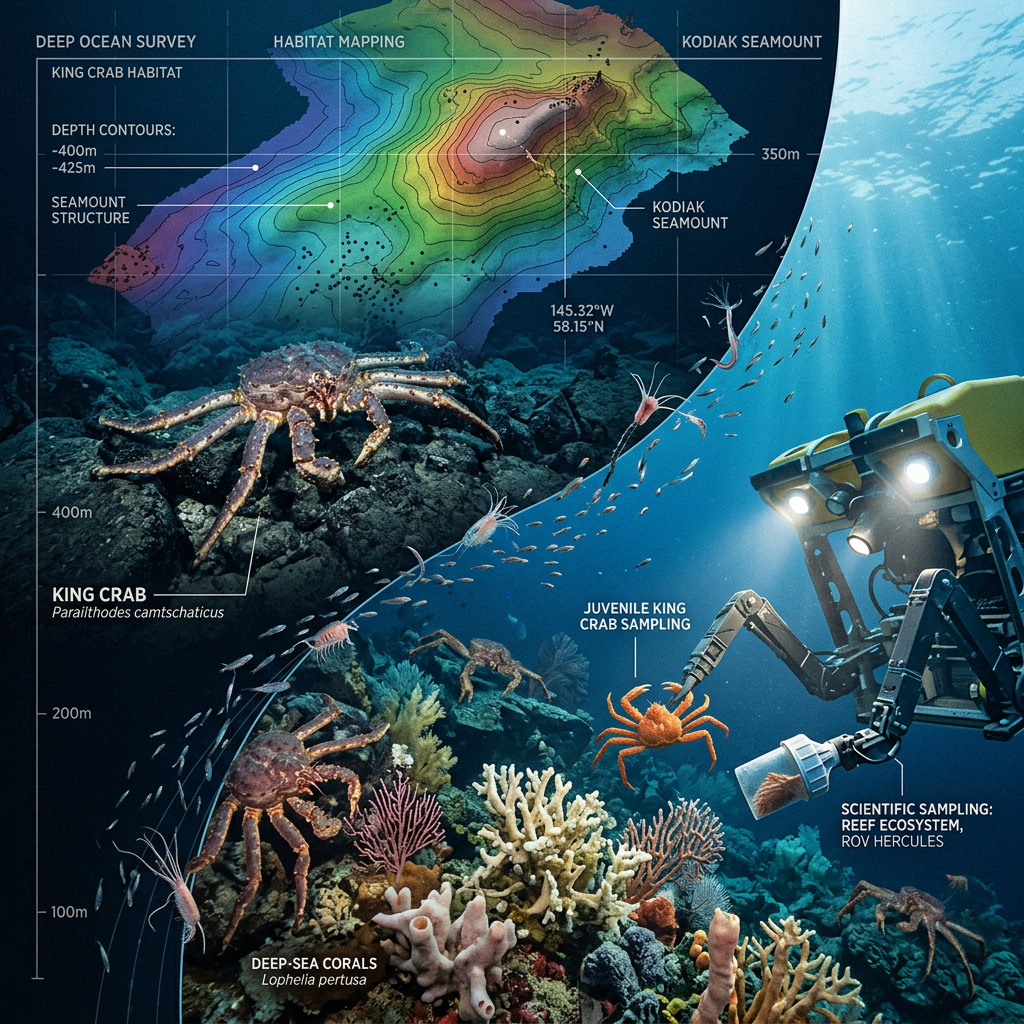
Traveling in search of aquatic delights, the exploration vehicle included a wrench claw head arm dissecting reef banks in view of marine food webs. Unmanned robots known as ROVs dove into deep water habits gathering data that trained audiences to consume science as a spectacle rather than a process.
Even when a deep-sea discovery was framed in deep and dark ocean water with bright underwater lighting, the audience can understand the amount of excitement researchers were feeling 12,800 feet below the surface while they stored their discoveries inside cylinders.
Ultimately, separating the factual core from the viral embellishment reminds us that real science is infinitely more rewarding than fiction. The patience required to read an institutional mission log, check a taxonomic classification, or listen to a marine biologist explain pressure adaptation yields a deeper, more enduring kind of awe—one rooted in understanding how our planet actually works, rather than just being startled by it.









Leave a Reply