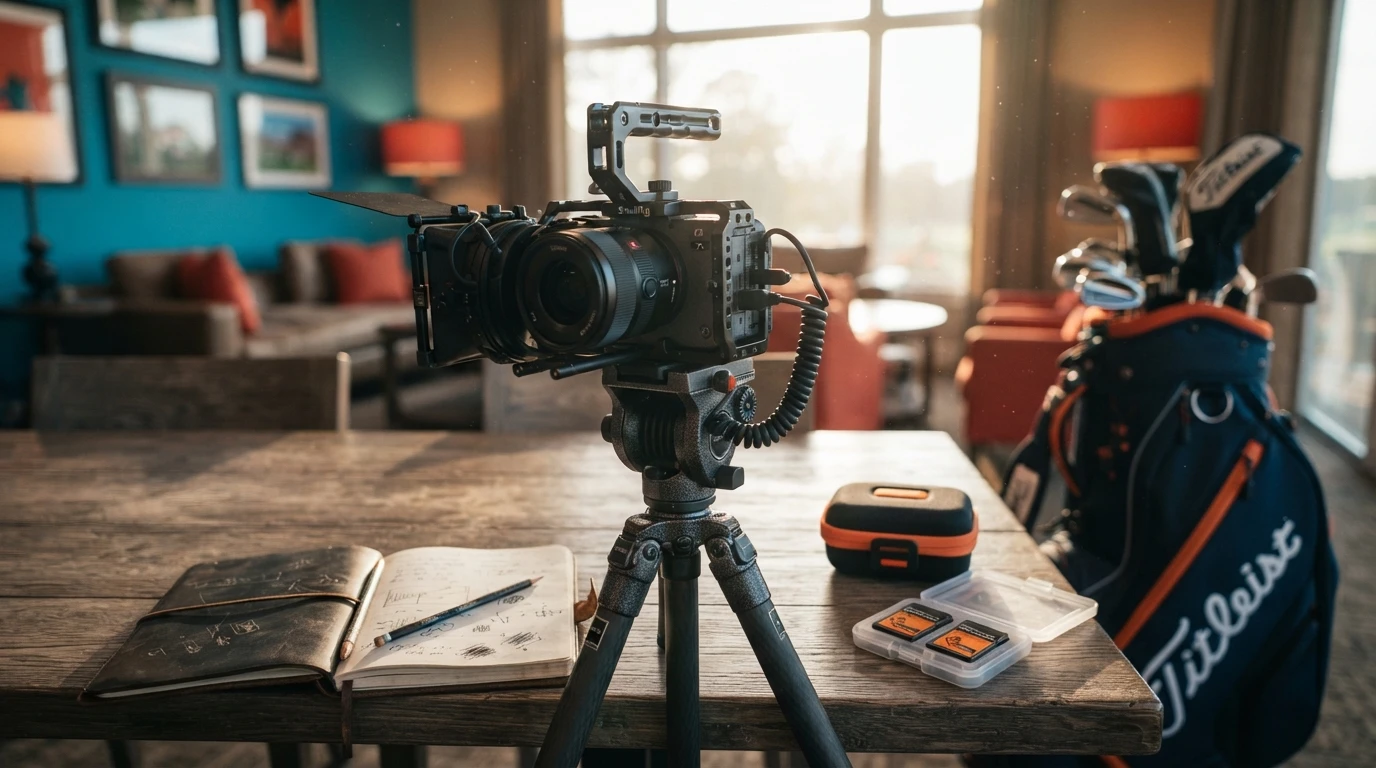
If you’re searching how to become a content creator, the fastest path is to stop “posting” and start producing: choose a niche you can shoot weekly, build a simple repeatable workflow (capture, edit, caption, publish), and measure what viewers actually watch so your style gets sharper without burning you out. This blueprint is built for golf storytellers, lifestyle brands, and corporate teams who want cinematic output without guessing.
Key Takeaways
- Build a niche and “watchable style” before you buy gear; clarity beats equipment every time when you’re starting from zero.
- Use a repeatable capture-to-edit cadence with shot lists, clean audio, and fast captioning so you can publish weekly without scrambling.
- Track retention, saves, and click-through rate, then revise your hooks and thumbnails like a producer, not a hobbyist.
Table of Contents
- What Does It Mean to Become a Content Creator in 2026?
- How Do You Pick a Niche and Content Style People Actually Watch?
- What Gear, Workflow, and Editing Cadence Make You Consistent?
- How to Become a Content Creator on TikTok, Instagram, and YouTube (Without Posting Randomly)
- How Do You Publish, Measure, and Improve Without Burning Out?
- Frequently Asked Questions
What Does It Mean to Become a Content Creator in 2026?
Content creator definition: a creator is someone who repeatedly captures, edits, packages, and distributes media that earns attention from a specific audience and produces a measurable outcome, whether that outcome is brand lift, leads, or a loyal community.
In 2026, “what is a digital content creator” has a sharper meaning than it did a few years ago: you’re competing in feeds where platforms reward retention, replays, and shares, and where brands expect content that looks intentional across vertical video, long-form, and stills. A social media content creator is not a person with a camera. It’s a person with a production system.
For our world at Avello Brand Company, that system is rooted in cinematic golf and documentary-style storytelling: the kind of visually stunning capture, photography, editing, captioning, and design concepts that make a brand feel like a lifestyle, not an ad. If you want a reference point for what “documentary golf” pacing and visual identity can look like in the real world, browse the SSODSTYLES field notes and galleries in the SSODSTYLES golf content collection.
Two truths that save beginners months:
First, you don’t “become” a creator when you hit a follower number. You become one when your process produces publishable work on schedule. Second, cinematic does not mean complicated. It means controlled choices: framing, light, sound, pacing, and a story spine the viewer can feel.
How Do You Pick a Niche and Content Style People Actually Watch?
How to become a content creator with no experience starts with a niche you can access, not a niche you admire. If you can’t film it weekly, it’s not your niche yet.
For golf storytellers and lifestyle brands, the niche decision usually has two layers: the subject (golf, travel, fitness, luxury lifestyle, corporate culture) and the angle (instruction, entertainment, documentary, behind-the-scenes, product storytelling). The “style people actually watch” is the overlap of what you can shoot consistently and what your audience can instantly recognize.
A practical way to choose is to commit to three content pillars you can rotate without thinking. For golf, strong pillars often look like: a round narrative (tension, mistakes, momentum), a skills micro-story (one swing thought, one drill, one result), and a gear or lifestyle moment (what’s in the bag, course culture, travel rhythm). Corporate teams can translate that into: brand story (why you exist), proof (how it works, behind the scenes), and people (founders, athletes, customers).
This is also where creators get confused about UGC. What is a UGC content creator? A UGC creator makes user-generated style assets for brands that feel native to the platform, often shot on a phone, usually delivered as raw and edited variations. A user generated content creator can be a great entry point if you want paid work fast, but it’s a different game than building a personal channel. UGC is a deliverables business. A channel is a compounding audience asset.
If you’re building a cinematic documentary voice, your differentiator is usually not “better camera.” It’s your ability to structure a scene. A golf round becomes watchable when it has: a clear objective (breaking 80, first time at a course, match play stakes), visible friction (wind, nerves, a double bogey), and a payoff (a late surge, a lesson, a moment of calm). You can see how that narrative frame shows up in pieces like Breaking 80 at Miami Shores Golf Club, where the title itself signals stakes and momentum.
What Gear, Workflow, and Editing Cadence Make You Consistent?
Social media content creator tools matter, but only after your workflow is stable. Consistency comes from reducing decisions on shoot day and edit day, then keeping your capture clean enough that editing is assembly, not rescue.
A “Content Creator Machine” That Actually Works
A content creator machine is a repeatable production loop: pre-produce, capture, ingest, edit, package, publish, review. When it’s working, you can miss a day and still ship, because the system has slack.
Here’s a lean gear stack that supports cinematic output without turning every shoot into a technical project:
Audio is the silent separator. Viewers forgive a slightly imperfect image. They do not forgive muddy speech. If you’re filming golf, capture natural sound on purpose: tee peg snap, club strike, ball roll, wind through trees. That’s documentary texture.
A Shoot-Day Workflow You Can Repeat
The easiest way to stay consistent is to shoot in blocks and use a shot list that forces coverage. For documentary-style golf or brand content, you’re usually building scenes from a small set of repeatable angles: wide establishing, medium action, tight detail.
Use a simple capture structure:
- Establish the location (course entrance, first tee, locker room, event space).
- Capture the objective (score goal, brand goal, product claim, interview prompt).
- Collect b-roll details that can bridge edits (hands, bag zips, ball markings, signage, shoes on path).
- Record one clean piece of narration or interview audio that can carry the story.
That’s it. You’re not trying to film everything. You’re trying to film enough to edit fast.
If you want inspiration for how stills and motion can share one identity, scan the photo-forward pacing in Golf Styles at Beach Club. The lesson is not the location. It’s the discipline: details, textures, consistent framing choices.
Editing Cadence: The Weekly Rhythm That Prevents Burnout
A beginner mistake is editing like every video is a feature film. Your cadence should match your distribution.
A sustainable weekly cadence for one creator looks like:
- One “anchor” piece (60 to 180 seconds for Reels/TikTok, or 6 to 12 minutes for YouTube)
- Two support cuts (15 to 30 seconds) pulled from the same shoot
- A small set of stills or hero frames for thumbnails and posts
Captions are not optional on short-form. TikTok and Instagram both play in environments where many viewers watch muted. Treat captions as part of the design, not an accessibility afterthought. For standards and best practices, the W3C Web Content Accessibility Guidelines (WCAG) are a useful baseline for readability principles that also improve watchability.
How to Become a Content Creator on TikTok, Instagram, and YouTube (Without Posting Randomly)
How to become a content creator on tiktok is mostly about packaging: the first second, the first line of on-screen text, and the first cut. TikTok rewards immediate clarity. Instagram rewards polish and saves. YouTube rewards satisfaction and session time.
Start by deciding what each platform is for in your system:
TikTok is your testing lab for hooks and story angles.
Instagram is your brand gallery and relationship engine.
YouTube is your library, where long-form documentaries and sports documentaries can live and compound.
A practical publishing framework is to ship the same story in three formats:
- Vertical short: one scene, one objective, one payoff.
- Carousel or stills: the best frames, with a caption that adds context the video cannot.
- Long-form: the full arc, with breathing room and documentary pacing.
Thumbnails and hooks are production decisions, not marketing afterthoughts. YouTube itself explains that titles and thumbnails drive clicks, but the video must deliver to earn watch time and long-term performance, which is why retention matters more than vanity metrics. Their official guidance is worth reading straight from the source in YouTube Creator Academy on thumbnails and titles.
If you’re building golf content, you can also anchor a series around a recurring objective. “Breaking 80” is a classic because it creates stakes without needing manufactured drama. The point is the structure, not the number. For a feel of how a recurring arc supports repeatable episodes, see Breaking 80 at Greynolds Golf Course.
How Do You Publish, Measure, and Improve Without Burning Out?
Publishing without burnout comes from measuring the right signals, then editing your process, not your identity. You’re not trying to become a different person every week. You’re refining the same voice.
The metrics that actually guide creative decisions are platform-specific, but three are nearly universal:
Retention (how long viewers stay), replays (whether they rewatch), and saves/shares (whether it was valuable enough to keep or send). For YouTube, watch time and audience retention are central, and Google’s documentation on measurement culture is clear: instrument your work, then iterate. For a grounded overview of how measurement supports better marketing decisions, Google’s own Analytics documentation is a reliable starting point even if you’re measuring on-platform first.
Here’s a simple review ritual that keeps you improving without spiraling:
After every post, note one thing that worked (hook, pacing, sound, caption clarity) and one thing to change next time (first frame, lower thirds, tighter cut, stronger objective). Keep the notes tiny. The goal is momentum.
Burnout usually comes from one of two places: overproduction or unclear purpose. Overproduction is when every video has too many setups, too many angles, too many revisions. Unclear purpose is when you don’t know whether you’re building an audience, building a portfolio, or selling a service, so every post feels like it has to do everything.
If you’re a corporate marketing team, burnout often shows up as inconsistent brand identity: different fonts, different color grades, different pacing, different voices across campaigns. Lock a basic style guide early: caption style, thumbnail layout, intro pacing, and audio leveling targets. That’s how cinematic becomes scalable.
Frequently Asked Questions
How do I start being a content creator?
Pick a niche you can film weekly, define three content pillars, and commit to a simple workflow: shoot, edit, caption, publish, review. The first month is about building the habit and learning what footage you actually need to edit fast.
What skills do I need to be a content creator?
You need story sense (objective, tension, payoff), basic production (framing, light, clean audio), and packaging (hooks, captions, thumbnails). Editing speed matters more than fancy effects because consistency is what compounds.
Do content creators make money?
Yes, but income varies by platform, niche, and business model: brand deals, UGC deliverables, affiliate revenue, products, services, and ad revenue (especially on YouTube). The creators who earn reliably treat content as a production pipeline tied to an offer or outcome.
What is the difference between videography and video production?
Videography is typically the act of filming, often as a solo operator capturing events or scenes. Video production includes pre-production planning, story structure, lighting and audio decisions, editing, packaging, and distribution, which is why it maps more closely to building a content system.
If you want your content to feel like a film and function like marketing, the shortcut is a tighter system: a niche you can access, a documentary-style structure you can repeat, and a workflow that makes publishing inevitable. When you’re ready to elevate your golf and brand storytelling with cinematic capture, photography, editing, and captioning built for modern feeds, reach out via Availability for Avello Brand Company production.









Leave a Reply