Coconut Grove Dry Cleaners Maintains the Integrity of the Fabric and of the Community


With owner Angel Espinosa passing over the business to his son Romulo, Coconut Grove Dry Cleaning continues to anchor a neighborhood despite decades of change.
Before its establishment in 1961, and service-oriented contributions to a community that wanted to preserve their garments, the owner of Coconut Grove Dry Cleaners escaped Fidel Castro’s communist takeover in Cuba, in fear of government retributions and imprisonment.
Angel Espinosa had no laundry background and was looking to purchase any business in the Coconut Grove neighborhood. He added his first shirt machine to the laundry store in 1963, and less than a decade later, he protected his interests and expanded it to a dry-cleaning operation.
As Coconut Grove Dry Cleaners continues to serve a neighborhood during a transformative period, the Espinosa family alongside The Allen Morris Company announced plans for a mixed-use development at 3101 Grand Avenue, located at the intersection of Grand Avenue, Matilda Street, and Florida Avenue in Coconut Grove.
According to Florida Yimby – an architectural web digest, an Espinosa Family representative said, “We desired to create something we could take pride in—an endeavor that leaves a meaningful and lasting legacy for future generations, and we believe we have found the best partner possible in Allen Morris Co. because of their commitment to embrace and preserve the Grove’s uniqueness.”
Unlike front-load washers, dry-clean steam pressers maintain the fabric’s integrity, this technique has proved to recover delicate garments of villagers in an upscale place to live.
For instance, dry clean steam presses contain multiple fabric settings and use chemicals that structure the garments more than a standard wash, it also offers a reliable service for a diverse community, and after all these years, dry cleaners still drive a personalized sense of order and relief by handling a chore that many people lack time or tools to manage. Or as Angel Espinosa said in an article published in Dec. 2000, “I know everybody and they know me. It’s like we’re family.”
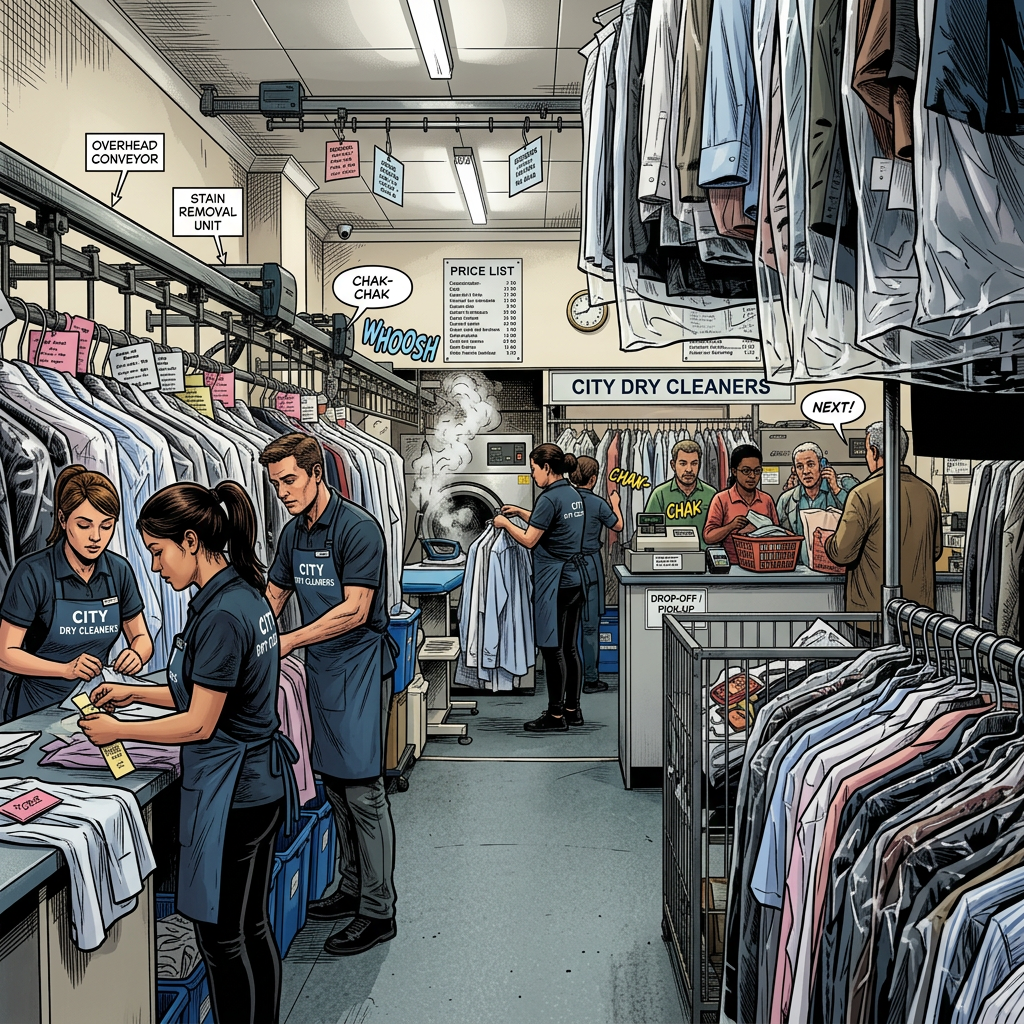
Coconut Grove Dry Cleaners begins each morning at 5:30 a.m., but Angel’s son Romulo shoulders most of the day-to-day work, starting with the prior day’s tagged walk-ins and drop-offs.
Before the items reach the back, Romulo is waiting at the front with his ticket pad.
As Romulo counts the items, he checks each item off on the identification pad before placing it on the table for tagging.
Each item is tagged with its ticket number, a tag that stays on throughout the wash and press cycle.
Once all the items have been placed in the yellow bins beside the tag table, they are passed to an associate who prepares the garments for a wash cycle – bins fill up every few hours and are distributed to their press locations.
Romulo Espinosa put it this way, “First of all, we are a family business providing a service for the community, then we’ve built a relationship with our clients, which they can rely on us to listen to their requests.”
Associates are stationed and surrounded at the next stop, by heavy-framed, industrial stacked washers with large durable button paneled, dry cleaning presses.
In the Hot Iron area, an associate starts with a gentle brush wash on items containing smudges, followed by the first machine press of the cycle, which has witnessed more women’s items, as women’s rights have evolved, over the years.
The station’s most impressive machine is the Laundry Cuff & Collar Press, a hard pressed – curved, fine pressing steam, for a high-quality finish.
Another classic machine is the Airbag sleeve unipress, which produces top quality, fully pressed sleeves using automatic cuff clamp measurement, and after a timed cycle release, the result is a high-quality uniform finish.
Finally, the shirt is placed inside the Thunder Double Buck Body Press by the associate and blasted with powerful steam carrying a formed vacuum of air that leaves a contoured chest look.
The Steam Press area is in the back of the space, and all the machine presses are dry cleaning presses that reach temperatures up to 145 degrees – not very high, but they use a combination of steam to relax fibers and warm air to dry.
The idea of selling the store emerged when land value soared in the 90’s, but the Espinosa’s said, “No, we’re going to stay here and continue coming to the store every morning.” Each item prices differently, somewhere in between $4.50-$5.50 for laundered business shirts, under $20 for cleaning and pressing on pants, jackets, sweaters, and shorts. Though some of the higher priced garments have prices that total $33-$34, each item prepares customers for their everyday responsibilities.
Four technicians operate the steam presses that reach 145 degrees: beginning with a hands-free mannequin steam press that uses innovative technology to smooth and dry fabrics in one step. Later, the technician places the garment on the string line, and the next technician places the garment on a dry cleaning double legger presser.
This process begins with another hot steam on the sleeves, a padded head, presses powerful steam for efficient wrinkle removal, and once a crisp finish is ready, they move the garments to a staging area for a professional finish.
There are two steel carousel conveyor belts, containing completed items, waiting to be picked up. The items are wrapped in blue foil and alphabetized on one belt, starting with A-K, and finishing with L-Z.
Orders rarely stay on the conveyor belts for longer than 30 days. Orders on the conveyor belt can range from 15 to 20 items; beyond that, they are placed in a separate location to minimize the weight of the conveyor belt.
These items are now ready to be worn out, for a night out on the town, or to work during the week. Dry Cleaning protects the garment, but with care and expertise Coconut Grove Dry Cleaners provides a professional laundry service.









Leave a Reply